

The use of fuel cells for stationary power applications is attracting growing interest as global electricity demand rises, increasing energy security concerns, and growing focus on decarbonization. IDTechEx forecasts that stationary fuel cell market is expected to reach US$11 billion by 2037, representing a CAGR of 21%.
The stationary fuel cell market is entering a period of growth as rising electricity demand, grid constraints, and decarbonization targets increase demand for reliable onsite power. IDTechEx forecasts that the global stationary fuel cell market will reach US$11 billion by 2037, growing at a CAGR of 21%. However, growth will vary significantly across both fuel cell technologies and applications. Solid oxide fuel cells (SOFCs) and proton exchange membrane fuel cells (PEMFCs) are expected to capture much of the market expansion. In terms of applications, data centers are emerging as a major driver of market growth. The latest IDTechEx report, "Stationary Fuel Cells for Data Centers, Commercial & Industrial Applications 2027-2037: Technology, Forecasts & Players", provides an in-depth assessment of key developments across fuel cell technologies and the market outlook for major stationary fuel cell applications.
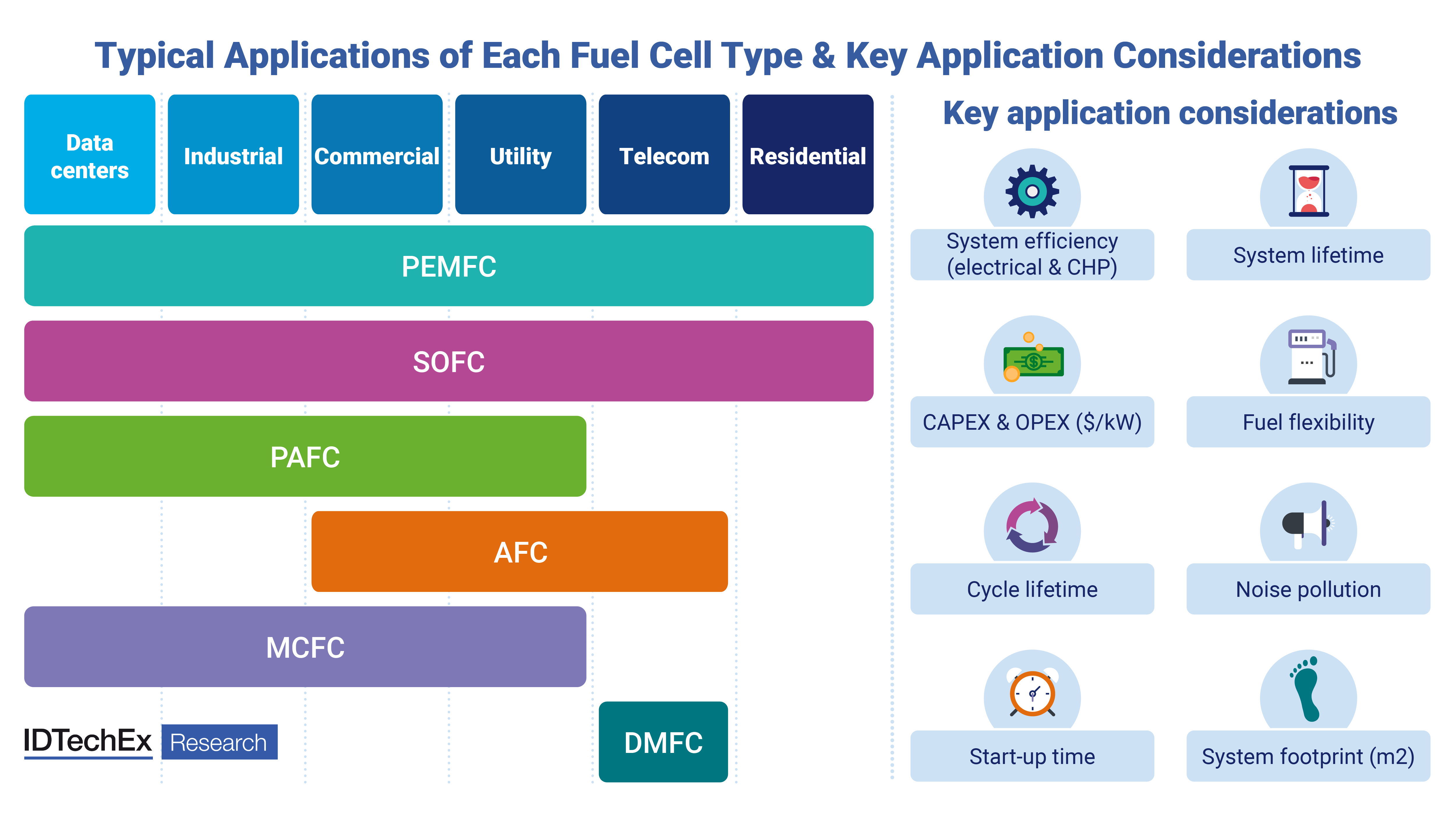
Overview of the typical applications for each fuel cell type and key application considerations. Source: IDTechEx.
Data centers create a new growth opportunity for stationary fuel cells
Data centers have traditionally relied on grid electricity with backup power generation. However, the rapid growth of AI and cloud computing is increasing both the scale of power requirements and the need for highly reliable electricity. Hyperscale data centers can require hundreds of megawatts or even several gigawatts of power, creating growing interest in technologies that can provide reliable onsite generation at this scale.
Grid availability is becoming a constraint on many data center developments. For example, in parts of the US, new grid connections can face lengthy interconnection queues and permitting requirements, delaying access to the power needed for new facilities. Fuel cell systems can provide onsite power generation without waiting for grid infrastructure to be expanded. This can bring new power capacity online faster, with some systems deployable within months compared with the years required for a new grid connection. Oracle's Project Jupiter demonstrates the growing scale of fuel cell deployment in data centers. The AI data center campus will use up to 2.45 GW of Bloom Energy's SOFC technology as its primary power source, making it one of the largest planned fuel cell deployments for a data center. The project also highlights the growing use of fuel cells for continuous onsite power, rather than only as backup generation.
The IDTechEx report compares the suitability of each fuel cell technology across stationary applications, supported by technology benchmarking, key case studies, and analysis of application-specific market trends.
Fuel cell technology choice depends on the application
The growth of data centers does not mean that one fuel cell technology will dominate across all stationary power applications. Different fuel cell technologies offer different performance characteristics, making factors such as power density, fuel flexibility, response time, and startup time important considerations when selecting a technology for a specific application.
For example, PEMFCs are well suited to backup power applications, where rapid response and high-power density are important. They can also provide a lower-emission alternative to diesel generators, supporting growing interest from commercial and critical infrastructure operators. However, larger-scale PEMFC deployment remains closely linked to the availability and cost of high-purity hydrogen. The slower development of the green hydrogen market remains a key limitation to scaling up PEMFC deployment.
In contrast, SOFCs are well positioned for primary baseload power generation. Their high electrical efficiency and fuel flexibility make them suitable for continuous power generation, while operating temperatures above 650°C allow SOFCs to internally reform fuels such as natural gas into a hydrogen-rich gas. This enables systems to use existing fuel infrastructure today, with the potential to transition toward low-carbon fuels such as hydrogen as they become more widely available.
Other fuel cell technologies are expected to remain relevant in more specialized applications where their specific performance characteristics offer advantages over alternative technologies. The IDTechEx report assesses the key materials and components used across each fuel cell technology, as well as technology development trends and the competitive landscape, including major commercial developments and financing activity of leading players.
Market outlook
As data center power requirements continue to grow and grid constraints become more significant, demand for onsite fuel cell generation is expected to increase. Growing interest from businesses seeking to decarbonize power generation while maintaining reliable electricity supply will also support wider fuel cell adoption. These trends are expected to drive long-term expansion of the stationary fuel cell market. The global market is forecast to reach US$11 billion by 2037, representing a 21% CAGR. The report provides granular 10-year forecasts for both stationary fuel cell demand in MW and market size in US$ million, segmented by fuel cell technology, application, and operating mode. Across six fuel cell technologies and six application sectors, the analysis provides 24 individual technology and application forecast lines through 2037.
For more information on this report, including downloadable sample pages, please visit www.IDTechEx.com/StationaryFC, or for the full portfolio of energy-related research available from IDTechEx, see www.IDTechEx.com/Research/Energy.
