

Globally, most of the electricity used by data centers comes from fossil fuels. While data center hyperscalers have long been offsetting this with market-based RECs (renewable energy certificates) and PPAs (power purchase agreements) from wind and solar projects, a transition to location-based and time-matched accounting is anticipated. This will demand new investment in low-carbon technologies that can meet the continuous power needs of data centers. IDTechEx's "Sustainability for Data Centers 2027-2037: Green Technologies, Market Forecasts, and Players" report analyses the role emerging clean energy technologies could play in data center decarbonization.
Is solar still the answer?
Solar power is intermittent and therefore unsuited to the continuous power demands of data centers. However, this can be addressed combining solar power with battery energy storage. Grid-scale energy storage continues to rise globally as more renewable capacity is brought online. Additionally, microgrid/offgrid solar paired with batteries for data centers is becoming increasingly competitive with onsite gas turbines and grid connections. While IDTechEx expects Li-ion technologies to remain dominant, IDTechEx's "Sustainability for Data Centers 2027-2037: Green Technologies, Market Forecasts, and Players" report also examines opportunities for vanadium redox flow batteries, Na-ion batteries, second-life EV batteries, and other emerging long-duration energy storage solutions.
Interest has also emerged in somewhere with solar availability 100% of the time: Outer space. The rise in AI and increasing power demands of data centers has triggered many headlines surrounding space-based solar. In April 2026, Meta signed an agreement with Overview Energy to secure power from the start-up's space-based solar energy infrastructure (a system that can collect solar energy in space and transmit it to Earth through infrared lasers). Some companies - including SpaceX and Blue Origin - have proposed going further and putting entire data centers in space although high launch costs and thermal management requirements currently pose significant challenges.
What about nuclear?
Low-carbon baseload power is a key advantage provided by large-scale nuclear power plants. To reduce the costs of nuclear power and enhance safety, companies have been developing SMR (small modular reactor) technologies. Accordingly, data center hyperscalers have already began investing in SMR start-ups with different designs. SMR designs can be categorized by their different reactor technologies, with three of the most promising concepts being High-Temperature Gas-cooled Reactors (HTGRs), Liquid Meta Fast Reactors (LMFRs), and Molten Salt Reactors (MSRs). It is surely no coincidence then that Google, Amazon, and Meta have each made major commitments with SMR startups each developing a different type of reactor technology: Google with MSR startup Kairos Power, Amazon with HTGR developer X-Energy, and Meta with two different LMFR startups - Oklo and TerraPower. HTGRs, LMFRs, and MSRs are referred to as fourth generation (Gen IV) nuclear reactor designs.
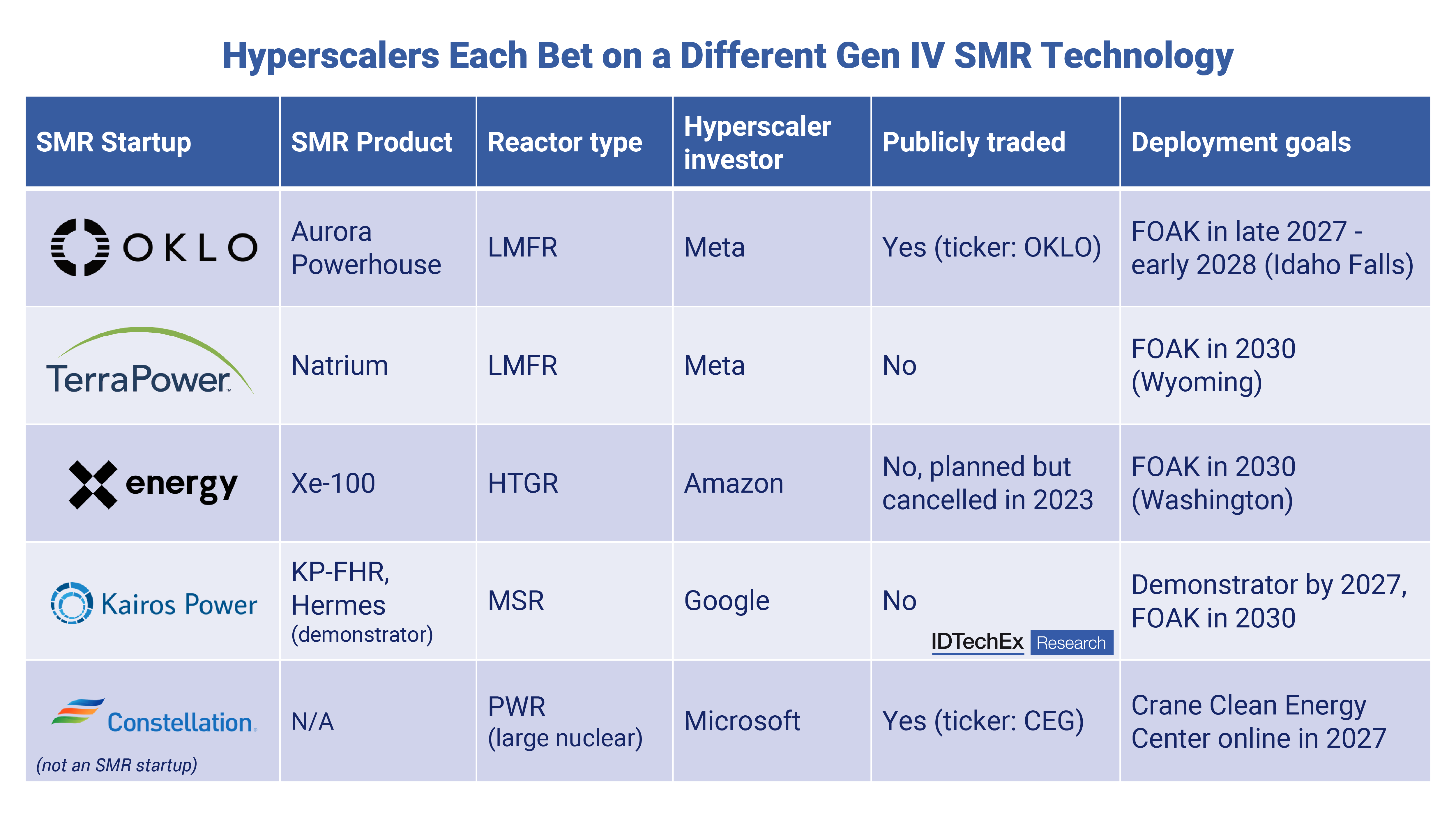
Data center hyperscalers are investing in SMRs. Source: IDTechEx
Nuclear is becoming part of the long-term solution for sustainable data center power, but will not be a near-term quick fix.
Can fossil fuels still be used?
Fossil fuels release CO2 emissions that cause climate change and negative environmental impacts. However, it is possible to use fossil fuels for power generation and still significantly decrease CO2 emissions. Fuel cells are a key example. Natural gas fuel cells release less CO2 than natural gas combustion processes. Additionally, these same fuel cells can later transition to run on 100% hydrogen as green hydrogen starts to scale. In January 2026, it was announced that American Electric Power (AEP) locked in a US$2.65 billion deal to deploy up to 1GW of Bloom Energy solid oxide fuel cells, which AEP will co-locate at AI data centers to support power needs.
Carbon capture is another solution - with the potential to reduce CO2 emissions from conventional fossil fuel power plants by over 95%. Carbon pricing support and CCUS funding is strong in North America and the EU, which can make the economics of carbon capture projects for data centers favourable. However, new large-scale CCUS projects can take over 5 years to develop, with limited availability of CO2 storage and transportation infrastructure currently. In October 2025, Google announced its "first carbon capture and storage project". Broadwing Energy, located in Decatur, Illinois, will capture and permanently store approximately 90% of its CO2 emissions from gas power generation. Technical, economic, and regulatory considerations for CCUS are explored in detail within IDTechEx's "Carbon Capture, Utilization, and Storage (CCUS) Markets" reports.
Outlook
Globally, data centers are demanding more power and consuming more electricity as the AI boom accelerates. According to IDTechEx's "Sustainability for Data Centers 2027-2037: Green Technologies, Market Forecasts, and Players" report, global installed data centre power capacity will exceed 300 GW by 2036 (about triple today's number). Therefore, to avoid AI becoming a threat to net-zero by 2050 targets, emerging low-carbon power technologies must continue to be scaled up.
For more information on this report, including downloadable sample pages, please visit www.IDTechEx.com/SDC, or for the full portfolio of related research available from IDTechEx, see www.IDTechEx.com.