

In December 2025, American semiconductor and technology giant Marvell acquired Celestial AI in a deal worth US$3.25bn. This is part of a flurry of activity in the wider photonics space, with NVIDIA investing $2bn each in Coherent and Lumentum, and IDTechEx's recent industry and technology report - "Silicon Photonics and Photonic Integrated Circuits 2026-2036: Technologies, Markets, and Forecasts" - indicates that 2026 is seeing explosive growth in the photonics industry driven primarily by AI interconnect demands.
AI Data Centers require enormous amounts of data to be sent between and within clusters of GPUs. As the demands on bandwidth grow, traditional copper interconnects are struggling to keep pace - and so the industry is switching to optics. Photonic integrated circuits (PICs) are a class of integrated circuits that can process both optical and electrical signals, and IDTechEx research indicates that optical transceivers are emerging as the key application for PICs.
Modulators
Silicon photonics is a subset of PIC that seeks to leverage the existing silicon semiconductor industry to scale photonics effectively. The main challenge with silicon photonics is its inability to produce light, and so the workaround is to pair a III-V semiconductor laser (usually indium phosphide) with silicon components. The light in the system is generated by a continuous wave (CW) laser, which, as the name suggests, produces continuous, stable, and unchanging light. For the purposes of photonics, this CW light is not very useful, it carries no information. To transmit a signal, the light must be 'modulated' to encode a signal onto it by varying the intensity, and the component that does this is a modulator.
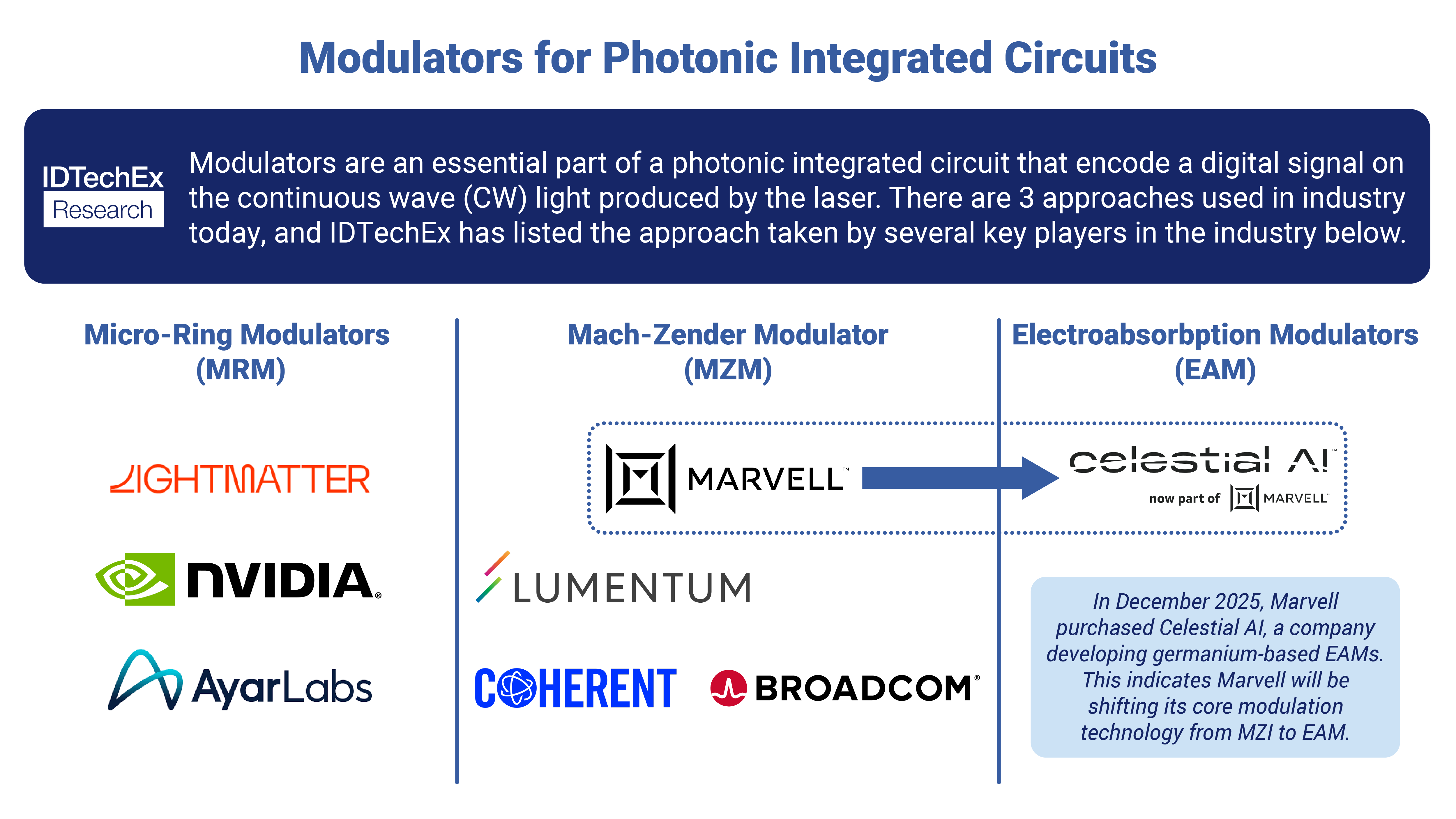
There are various types of modulators, but IDTechEx research has narrowed down the three most viable candidates for silicon photonics applications. The Mach-Zender Modulator (MZM), Microring Modulator (MRM), and Electroabsorbtion Modulator (EAM). Each of these has its own unique strengths and weaknesses, and Marvell's acquisition of Celestial AI brings a twist to the industry.
MZM - the industry standard
MZMs consist of two channels, which incoming light is split along. These two paths experience relative phase shifts and then are recombined. The phase shift is achieved by varying the silicon's refractive index via the free carrier effect. The main advantage of the MZM is its thermal stability, and also its ease of implantation. For this reason, it has long been the standard approach for photonic engineers, with optical transceivers from major players such as Coherent adopting this approach. However, there is a catch: varying the refractive index of silicon increases the loss of the waveguide, which means stringing multiple MZMs together is challenging. Due to the geometries of the modulator as well, it also takes up much more space than either MRM or EAM, a challenge for large-scale integration of components.
MRM - NVIDIA's and TSMC's CPO Engine
Co-packaged optics (Co-Packaged Optics (CPO) 2026-2036: Technologies, Market, and Forecasts ) is a highly integrated form of photonics that places the optics on the same substrate as the ASIC. This brings additional constraints on power and area, constraining modulator design. To overcome this, NVIDIA and its main foundry partner, TSMC, worked on another form of modulator, the microring design. In this setup, incoming light is passed through a ring connected to a through port and a drop port. Light is only passed through the MRM when the optical path through the ring is constructive interference, which is controlled by varying the refractive index of the ring.
MRMs are much smaller than MZMs and suffer from less insertion loss and so can be chained together more effectively. However, their big drawback is a lack of thermal stability. These rings are essentially microheaters, and highly sensitive to variations in temperature, something that NVIDIA has addressed by packaging the PIC outside of the switch, surrounded by a heatsink.
EAM, Celestial AI, and Marvell
Electroabsorbption modulators (EAMs) rely on the Franz-Keldysh effect, which is that an electric field applied to a semiconductor changes the absorption spectrum of the semiconductor, which in turn changes the bandgap energy. Marvell's acquisition of Celestial AI brings its photonics portfolio, which includes Germanium-based EAMs. Like most players, Marvell had historically been pursuing Mach-Zender based interferometers. However, with NVIDIA and Broadcom's strategic position growing increasingly strong in networking switches, Marvell has decided to make a commitment to a new, relatively unproven photonic technology that could have significant benefits over what competitors are using but faces several deployment challenges.
In principle, EAMs, could bring the thermal stability of MZMs with the low insertion loss and compact scalability of MRMs. This presents a technical differentiation with the rest of the industry, which is either shifting to MRMs on TSMC's COUPE platform or MZMs. However, SiGe EAMs are as of yet unproven in terms of reliability and longevity.
The photonics industry is rapidly evolving, driven by surging demand for high-performance networking in AI data centers. IDTechEx's latest research unpacks the latest updates across market landscape, technology innovation, and supply chains in this fast moving market that IDTechEx predicts will exceed US$48bn for optical transceivers alone by 2036.
For more information on this report, including downloadable sample pages, please visit www.IDTechEx.com/PIC, or for the full portfolio of research available from IDTechEx, see www.IDTechEx.com.
