

The audio industry may be on the verge of a technological revolution. For over a century, the operating principles of speakers have remained largely unchanged; an alternating electrical current drives permanent magnets to oscillate, which in turn drives a membrane. The motion of the membrane is what produces audible sound (itself pulses of vibrations in the air).
Speaker drivers with this architecture (such as coil drivers and balanced armatures) have proven incredibly successful; however, the requirement for permanent magnets, conductive coils, and housing means that speaker drivers are approaching miniaturization limits and still require complex, manual assembly. The latest report from IDTechEx, "Next-Generation MEMS 2026-2036: Markets, Technologies, and Players", explores the emergence of MEMS (Micro-Electro-Mechanical Systems) speakers and how this paradigm shift could change the audio industry.
MEMS Speakers and microphones
MEMS (Micro-Electro-Mechanical Systems) combine mechanical and electrical components at a microscopic scale. They are manufactured using the same batch fabrication processes that are used in the semiconductor industry, and as such can be produced at huge volumes at relatively low unit cost. Their small size also allows for more flexible integration into electronics, and they are often described as 'X-on-chip', for example, 'Speakers-on-chip'.
Speakers would not be the first audio component to shift to MEMS. Microphones perform the inverse function of speakers, converting an audio signal into an electrical signal. Microphones began shifting to a MEMS platform in the early 2000s when Knowles released its first array of commercial products. The real take-off moment for MEMS microphones occurred as smartphones (with billions of shipments a year) shifted wholesale to MEMS microphones in the early 2010s. MEMS microphones are now an established, mature market. With all the advantages of MEMS (small form factor, low power consumption), why have MEMS microphones become a billion-unit-a-year market, whereas MEMS speakers have yet to bridge the gap from the lab bench to the market?
As covered in "Next-Generation MEMS 2026-2036: Markets, Technologies, and Players", the main challenge for MEMS speakers has been producing a significant sound pressure level (SPL) at low frequencies - a challenge which MEMS microphones do not share, as they are provided with the air displacement by the input audio signal.
Fundamental physics of audio diaphragms means that miniaturized speakers struggle to produce a significant deflection at low frequencies, meaning MEMS speakers have often been used as 'tweeters' (high frequency drivers). However, true full frequency MEMS speakers remain the ultimate goal of the market, and IDTechEx has profiled the four main MEMS approaches to building a MEMS speaker; electrostatic, piezoelectric, electrodynamic, and thermoacoustic - and covers key players adopting each approach.
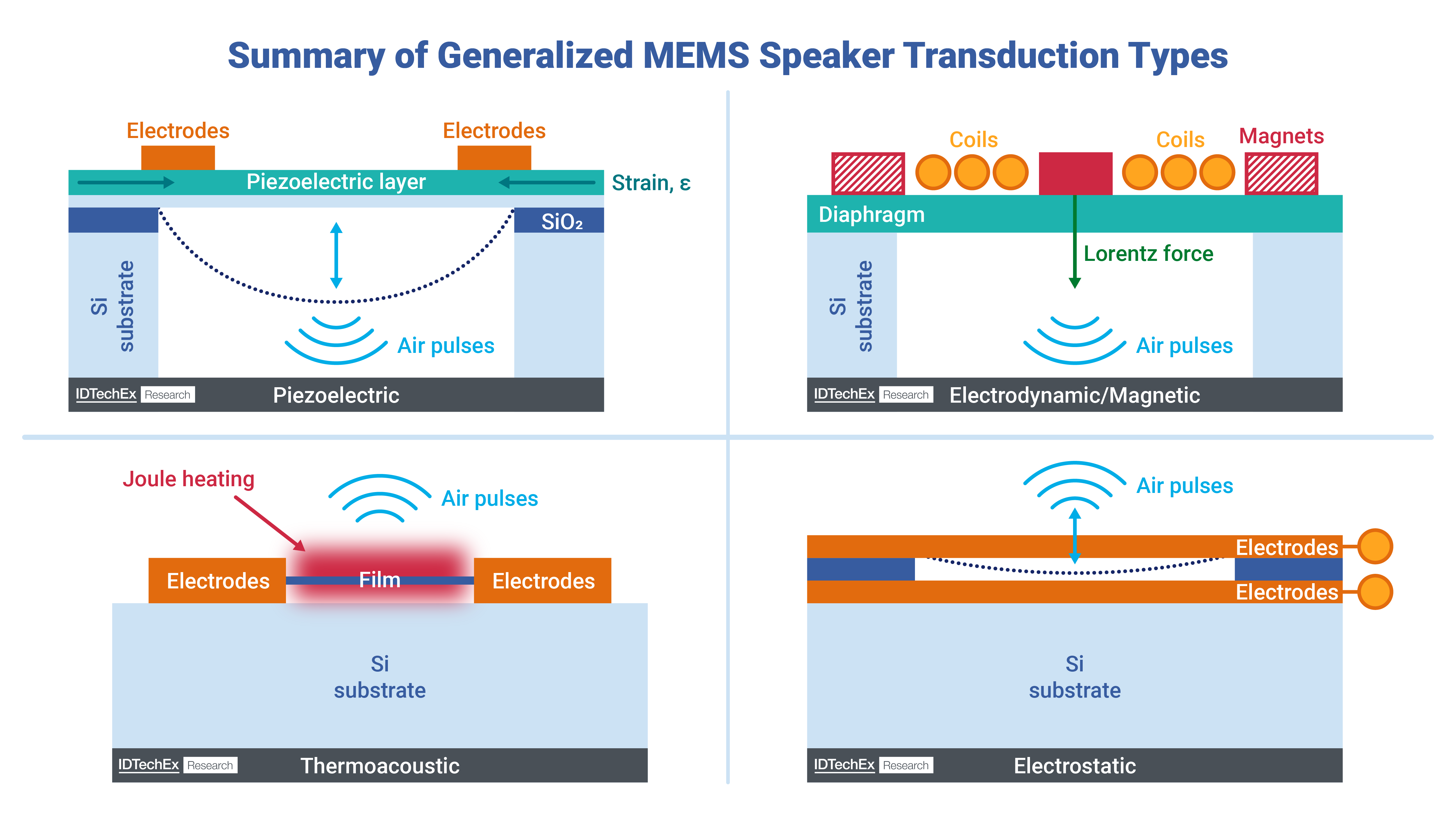
Different transduction methods of MEMS speakers. Piezoelectric and Electrostatic are the most commonly used, but designers often have to rely on additional techniques to produce sufficient low-frequency SPL e.g. ultrasonic amplitude modulation. Image source: IDTechEx.
Commercial activity - big players and startups
IDTechEx has tracked the MEMS speaker market and identified key players in the space - and explores market themes and dynamics. Why did Bosch Sensortech acquire a MEMS speaker academic spin-out, and what challenges has it encountered in its attempts to commercialize its 'nanoscopic electrostatic drive technology'? Which startups have adopted 'ultrasonic amplitude modulation' to overcome the physical challenge of producing a low frequency SPL? Which foundries have MEMS speakers partnered up with? What material choices do players have in constructing all MEMS speakers? All of these questions and much more are explored in-depth within this report.
True wireless stereo, the first application?
True wireless stereo (TWS) is a major market, and most MEMS speaker industry insiders spoken to by IDTechEx agree that it will be the first major application to adopt MEMS speakers. With the small form factor of TWS earbuds, space is at a premium and there is an increasing demand for longer battery life (meaning more space dedicated to the battery). MEMS speakers, with their small form factors, are appealing as they free up space while maintaining a high-quality sound output. TWS are also more premium products that can accept an initially higher unit cost than later devices on the adoption roadmap, such as smartphones.
"Next-Generation MEMS 2026-2036: Markets, Technologies, and Players" contains granular, 10-year forecasts for adoption in key application areas for MEMS speakers. IDTechEx has also benchmarked a comprehensive set of available products by SPL/frequency performance, unpacking the leaders and the laggards in the race to MEMS speaker commercialization.
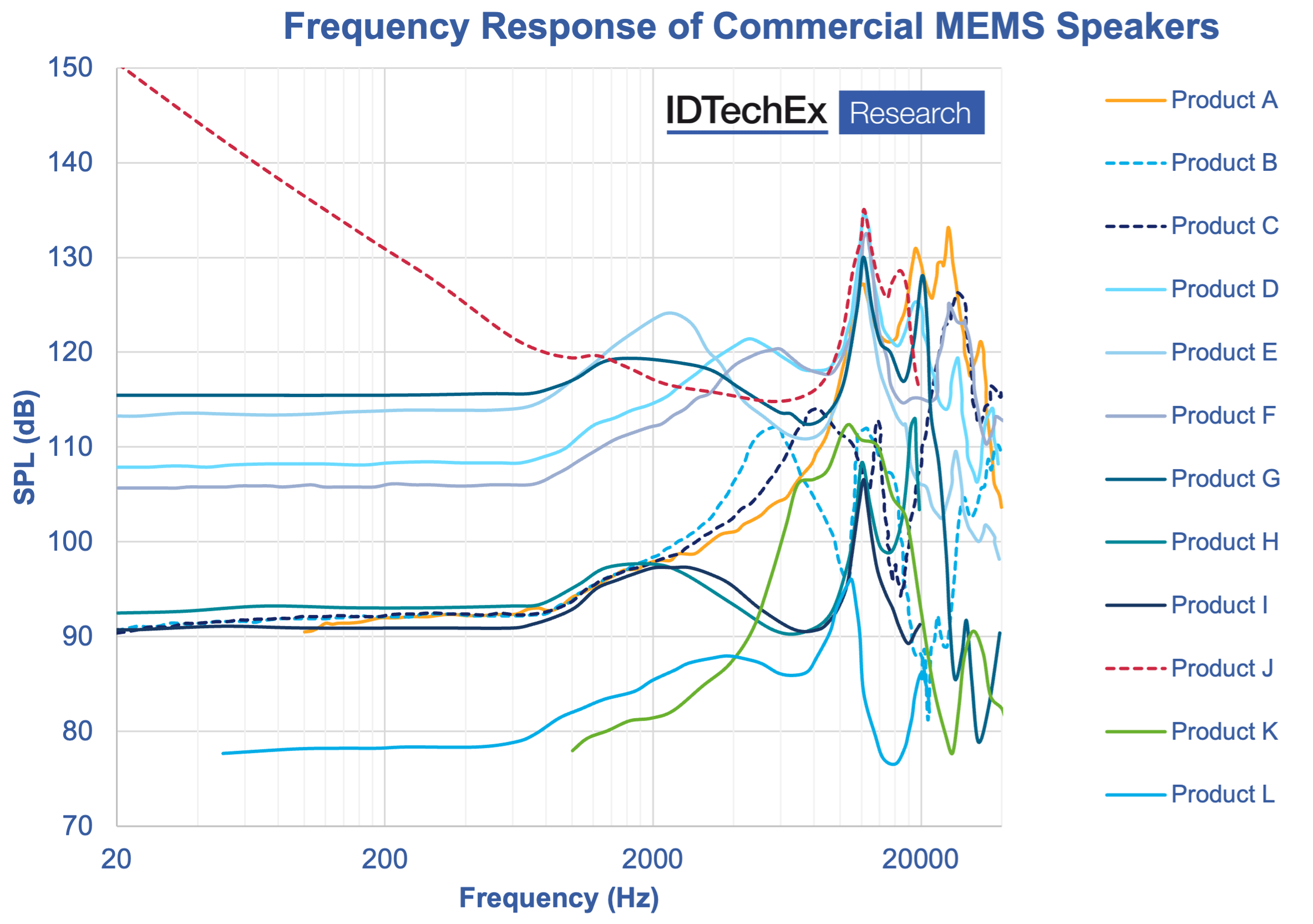 Comprehensive competitive landscape benchmarking of various MEMS speaker products that are on the market. Frequency response is a key differentiator of MEMS speakers, and IDTechEx analysis shows varied performance among the top players. Source: IDTechEx.
For more information on this report, including downloadable sample pages, please visit www.IDTechEx.com/NextGenMEMs, or for the full portfolio of research available from IDTechEx, see www.IDTechEx.com.
