

Could MEMS gravimeters be the next breakthrough in the MEMS industry? Gravimeters unlock subsurface scanning by measuring tiny deviations in local gravitational fields. Current gravimeters are large and expensive, but IDTechEx's latest report, "Next-Generation MEMS 2026-2036: Markets, Technologies, and Players", reveals that microelectromechanical systems (MEMS) could bring chip-scale gravimeters to market and dramatically alter the field of gravimetry.
Gravity, a fundamental force of physics, dictates almost every physical interaction on Earth. From keeping the Earth in orbit around the Sun, to holding the water in the Oceans, and enabling walking, it plays an inexorable role in nature and life. As every school pupil will tell you, the strength of the acceleration due to gravity on the Earth's surface is 9.8 m/s2. However, gravity is a function of the density and depth of the surface of the Earth below a single point, so gravity varies greatly from point to point, with up to a 0.7% (0.067 m/s2) deviation from the Peruvian mountains to the Arctic Ocean.
At much higher resolutions, deviations up to parts per million (or even billion), far more subtle deviations in the gravitational field can be detected that arise from the difference in density in underground materials. This unlocks the identification and mapping of mineral and petroleum deposits, groundwater reservoirs, voids, and buried assets, all from measuring the minute variations in the local gravitational field. Tracking changes in gravity over time also allows monitoring of active geological processes such as earthquakes, volcanic activity, and subsidence. Extremely precise networks of gravimeters can also be used to subtract out the seismic noise in an area, an emerging technique that is used in gravitational wave detection.
Gravity, as Einstein tells us, is indistinguishable from acceleration; therefore, an extremely precise accelerometer can detect these minute changes in the gravitational field. As reported in "Next-Generation MEMS 2026-2036: Markets, Technologies, and Players", the current incumbent technologies are expensive and cumbersome. MEMS are microscopic components that combine both mechanical and electrical components. For an accelerometer, the mechanical component usually involves a mass on a spring that is displaced under acceleration. The electrical component then translates this displacement into an electrical signal that is then read out as acceleration. While this simple design is used in billions of MEMS, from car airbag sensors to inertial measurement units, the extreme precision required for a MEMS gravimeter calls for a different approach.
The main technical challenge with MEMS gravimeters has been reducing the intrinsic 'noise-floor' of such sensors, which is the accumulation of random signals that 'cloud' the true gravitational field reading. "Next-Generation MEMS 2026-2036: Markets, Technologies, and Players" covers the cutting-edge developments aimed at reducing this noise floor, pioneered by academic institutions and startups.
The use of geometric anti-springs (GAS) is an emerging approach gaining some commercial traction that artificially softens the springs and was first pioneered in gravitational wave detection. With noise floors less than 100 nano-Gal's (1/10,000,000th gravity), GAS gravimeters are a promising approach to achieving MEMS gravimeters. But major questions remain, such as what readout scheme (optical or capacitive) is preferable, as well as the role of resonant beam accelerometers. IDTechEx takes a deep dive into the market and technologies of MEMS gravimeters.
Wider context in the MEMS accelerometer market
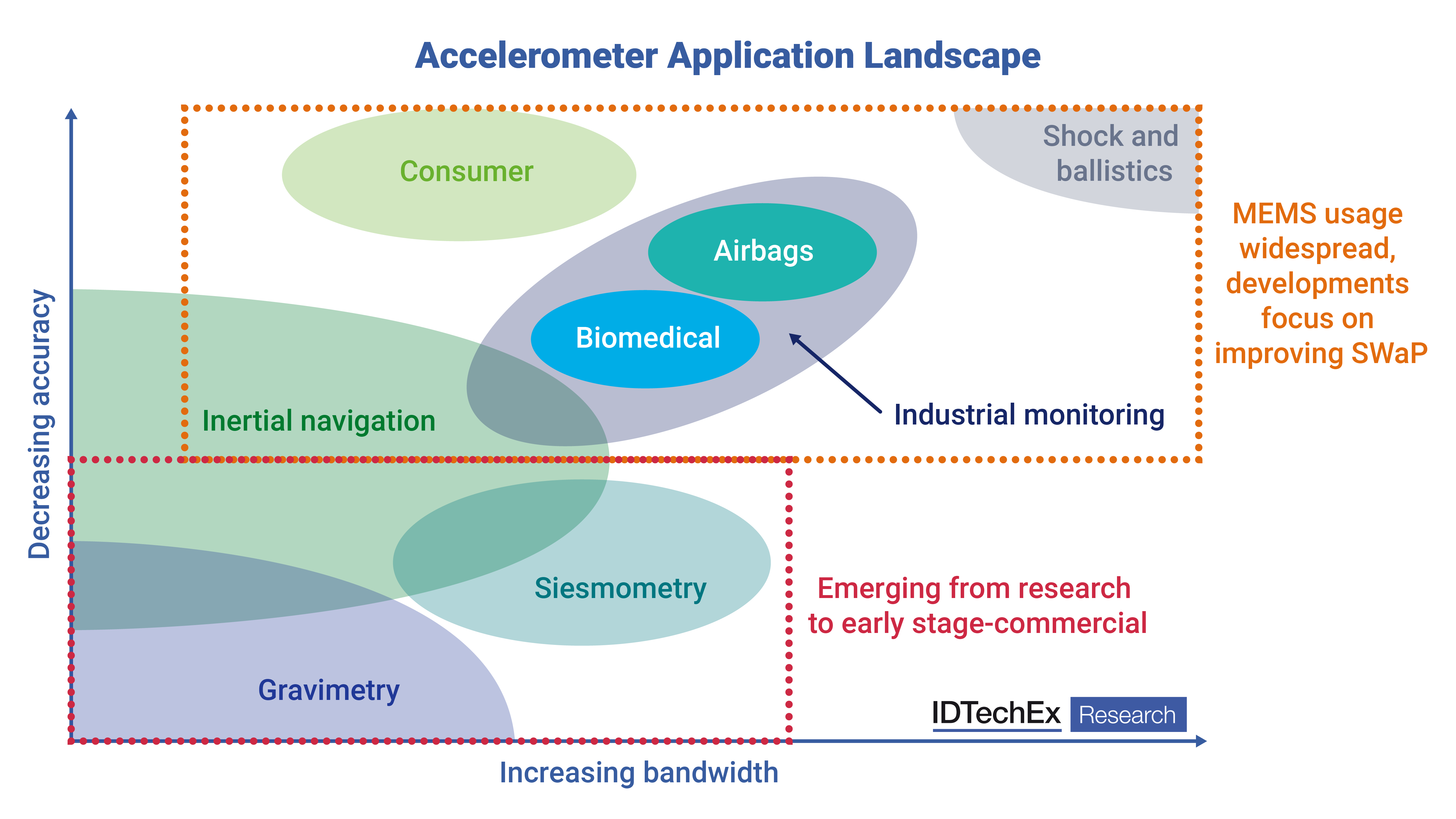
The development of MEMS gravimeters is but one aspect of the broad MEMS accelerometer market, which includes novel applications such as Siesmometry as well as established technologies such as airbag sensors, consumer electronics IMUs, and industrial monitoring. Source: IDTechEx.
The MEMS market continues to evolve, but the road from the lab-bench prototype to a foundry producing billions of chips a year is a long and arduous one. Not all technologies will find the necessary market appetite waiting for them at the end of their technology development. IDTechEx examines the most promising 'next generation' MEMS technologies and assesses their technical development, but also market dynamics and outlook for the next decade. "Next-Generation MEMS 2026-2036: Markets, Technologies, and Players" provides vital market intelligence and coverage of the emerging MEMS market.
For more information on this report, including downloadable sample pages, please visit www.IDTechEx.com/NextGenMEMs, or for the full portfolio of research available from IDTechEx, see www.IDTechEx.com.
